THE MILDEST OF SPOILERS!
“There’s something terrible about the way normality asserts itself. About the way that summer insists on happening. About the way the chestnuts blossom and Wimbledon takes place.”
I have to admit Flesh wasn’t on my radar at all until it was shortlisted and later won The Booker Prize (i.e. The Oscars of the book awards). I saw it quickly accumulate glowing reviews across the media, and it was being recommended to me left, right and centre as a great book to read. And so, coupled with a bit of fomo and my wish to kick-start my reading for the new year, I decided to give Flesh a listen/read!
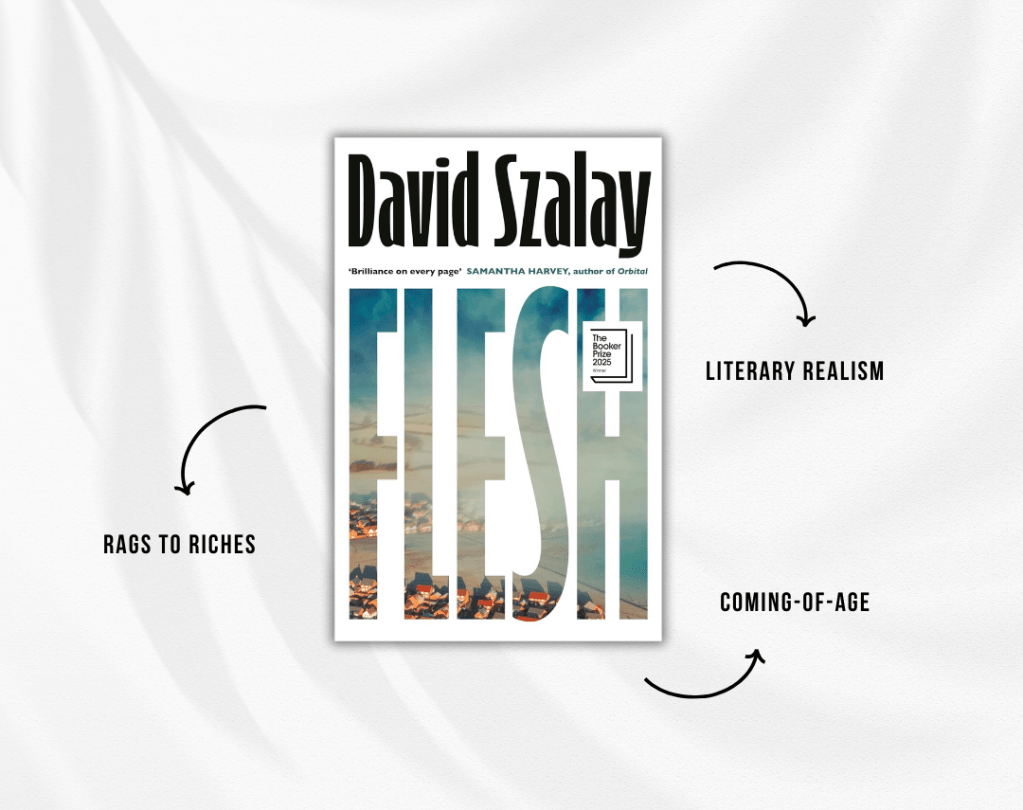
SYNOPSIS: Through chance, luck and choice, one man’s life takes him from a modest apartment in Hungary to the elite society of London – in this captivating new novel about the forces that make and break our lives.
REVIEW:
After much thought about why Flesh seems to have received such an overwhelmingly positive response, the best way I could make sense of it (and this may be a bit far-fetched) was to compare it to perhaps one of the best (and my personal favourite) bildungsroman – Jane Eyre. Flesh is a modern bildungsroman, and its main protagonist, István are almost the antithesis of everything that makes up the story of Jane Eyre. Jane, throughout most of the novel, is driven, has a strong sense of self, is aware of her position in the world, and is also able to stand up for herself. She’s a character who has to rely heavily on herself to navigate society as a lone woman. I think what I’m trying to say is that his journey didn’t feel like it showed much progression in who he was as a person, and no one ever really, truly and earnestly sits him down to tell him this. I often found myself feeling frustrated by many – if not most – of the decisions he makes, particularly in adulthood. This was something I couldn’t quite wrap my head around in terms of his portrayal. István, in my opinion, isn’t written to be simple-minded, naive at times, yes, but he demonstrates a level of introspection that doesn’t always seem to align with his choices or actions.
One of the most divisive elements of this novel is the prose and especially the dialogue, or the lack thereof at times. I would have attributed this to the language barrier between some of the characters, but the sparse style of prose is used throughout the novel by several characters with whom István interacts, both familiar and not, which frequently left me wanting more, especially from the dialogue. (Take a shot every time someone says Okay or I don’t know throughout this book…).
What I did end up appreciating and thought Szlay did portray wonderfully was how István’s story managed to feel both distinctive and, in many ways, universal. In the same manner, we all can pass by someone in a supermarket, on a busy street, or at the gym and have absolutely no idea what that person has been through or is going through. Many of whom are men who, because of society, have to or sometimes need to portray themselves in a particular way to fit in, assimilate or simply survive, which, I would argue, is the novel’s central purpose.
Would I recommend Flesh?
I would say that it is entirely up to you. It’s not a book I would normally have picked up, but I’m glad I managed to finish it in the end, even though I came very close to adding it to my DNF pile several times.
Overall, I don’t think you will fall in love with this world, or its characters, but you will love and come to (like I did) appreciate what Flesh has to say about the human condition and those who are both incidentally exposed and/or shaped by its many forces.
3/5 ⭐
 THE-RAVE
Leave a comment